

Leeds-led study shows potential of terahertz frequencies for high-speed, secure communications
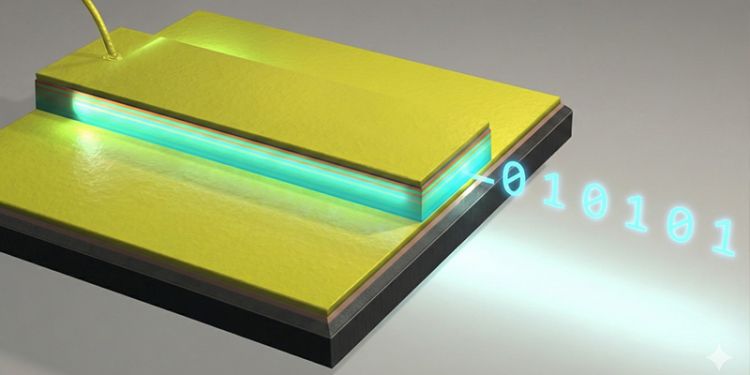
A new experiment at the University of Leeds suggests that the future of high-speed wireless communication may lie in a largely unused region of the electromagnetic spectrum.
In “Free-space optical communications at 4Gbit/s data rate with a terahertz laser”, published in Communications Physics, the team demonstrated how terahertz-frequency light can be used to transmit data wirelessly, through open air, at speeds far beyond those previously achieved at these frequencies.
Terahertz waves sit between microwaves and infrared light, offering much greater available bandwidth than the radio frequencies used by Wi-Fi and 5G, but they have been difficult to harness for reliable, high-speed communication.
The Leeds team, which includes Dr Jayaprasath Elumalai, Dr Joshua Freeman, and Professor Giles Davies, together with colleagues from University College London (UCL), overcame this challenge by directly modulating a terahertz-frequency quantum cascade laser (QCL) with data and detecting the transmitted signal using a specialised semiconductor diode. This created a free-space optical communication link that does not rely on physical cables or fibre.

Dr Jayaprasath Elumalai and Dr Joshua Freeman led the research.
Using this approach, the researchers achieved data transmission rates of up to 4GB/s, approximately 200 times higher than earlier terahertz communication systems, which were typically limited to kilobytes or megabytes per second.
The ability to send data at these speeds opens several potential applications:
- In data centres, terahertz links could provide ultra-fast, cable-free connections between server racks, supporting low-latency cloud computing and more flexible infrastructure.
- In space, the technology could enable high-capacity links between satellites, avoiding the signal losses caused by Earth’s atmosphere.
- The highly directional nature of terahertz beams also makes them inherently more difficult to intercept than conventional radio signals, offering advantages for secure point-to-point communication in sectors such as defence, finance and healthcare.
Dr Elumalai said: “The main challenge was tuning the terahertz quantum cascade laser to act like a clean, high-speed transmitter that would transmit the signal without distortion. Once we achieved that, we were able to push the laser to transmit high data rates and reliably recover the information.”
Dr Freeman added: “We’re excited that these terahertz lasers that we have developed can be used to transmit data at high speed. This part of the spectrum is underutilised, and so there is a lot of potential.”

Dr Elumalai and Dr Freeman analyse the transmission of data via terahertz technology.
Together with UCL, the work was carried out in partnership with the University of Cambridge and Swansea University, and is supported by a five-year, £7 million programme grant from the UKRI Engineering and Physical Sciences Research Council (EPSRC).
The collaboration brings together Leeds’ world-leading expertise in terahertz electronic and photonic systems and quantum cascade laser fabrication, alongside UCL’s strengths in communication systems and photonic design.
The researchers are now working to extend the system beyond simple on/off signalling to more advanced data modulation schemes. With further development of higher-power devices, the approach could support even greater data rates while helping to relieve pressure on increasingly congested wireless frequency bands.
This research also runs alongside a deeper partnership between Leeds and Swansea. The universities recently announced a major initiative, backed by the UK Government, to address the UK’s semiconductor skills gap with the launch of a new Centre for Doctoral Training (CDT).
Further information
- For media enquiries, please contact Faculty Communications Manager Matt Gardner at M.D.Gardner@leeds.ac.uk.
- Lead image inspired by Wang et al’s “Short Terahertz Pulse Generation from a Dispersion Compensated Modelocked Semiconductor Laser”, published 7 July 2017.


