

Particle and materials characterisation
- Overview: Analytical facilities for characterisation of particles, powders, slurries, suspensions, emulsions and solutions.
- Contact name: Dr Ben Douglas
- Phone: +44 (0)113 343 2378
- Email: b.douglas@leeds.ac.uk
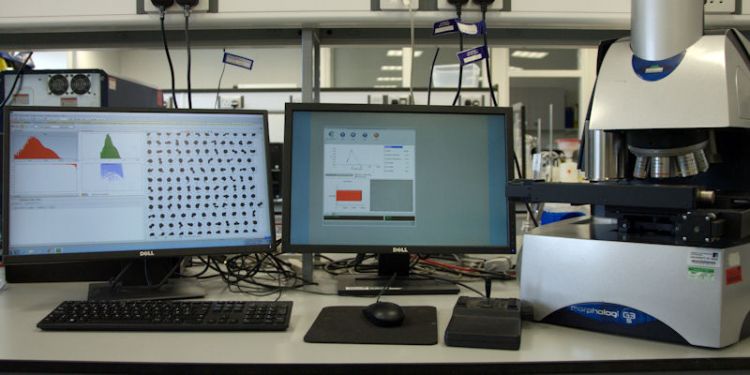
We have a range of instruments for obtaining particle size distributions from a few nanometres to hundreds of micrometres, for particulate-based systems in wet or dry dispersions.
Particle morphology can be studied using an automated static image analyser, which measures size and shape parameters.
Other solid materials characterisation includes gas sorption instruments for surface area and porosity measurements, and vapour sorption equipment (water or organic vapours).
Rheometers are available to study viscosity and flow properties of liquids and semi-solids, and a tensiometer for contact angle and surface tension measurements.
Equipment
- Dynamic light scattering: The Malvern Zetasizer Advance calculates particle size distributions from light scattering measurements of nanoparticles (a few nanometres up to 10 microns, depending on system properties) dispersed in a liquid.
- Laser diffraction: A Malvern Mastersizer 3000 can be used to measure particle size distributions in the range 0.1 – 1000 microns. Materials can be dispersed in a liquid or studied as dry powders.
- Particle size and shape: The Malvern Morphologi 4 is a microscope-based imaging instrument that analyses tens of thousands of individual particles to produce information on particle size and morphology. A dynamic system, the FlowCAM, captures similar data using a flow cell and a strobed light source.
- Sedimentation and stability analysis: Settling or creaming behaviour can be studied under gravity using a Fullbrook Turbiscan instrument, or under centrifugal conditions with the LUM LumiSizer, by measuring changes in light transmittance through the sample at time intervals. This can also give information on particle size (20 nanometres – 100 microns).
- Zetapotential: Malvern Zetasizer Advance and Anton Paar SurPASS are available to measure the surface charge of suspended particles or solid samples via electrophoretic or streaming potential techniques.
- Surface area and porosity: Nitrogen adsorption can be used to measure surface areas (e.g., BET analysis) and pore sizes or volumes of micro and mesoporous solids using Anton Paar Nova 800 and Autosorb 6100 instruments. Measurements can also be carried out using carbon dioxide or krypton.
- Dynamic vapour sorption: The Surface Measurement Systems DVS Resolution monitors sample mass under controlled temperature and relative humidity. Water or organic solvent uptake can be measured.
- Density measurement: A Micromeritics AccuPyc helium pycnometer is available to measure the skeletal density of solids.
- Rheology: The Anton Paar Physica MCR301 rotational rheometers are used to measure viscosity, creep, relaxation, or oscillation at variable temperatures and shear rates. Cone & plate and cup & bob geometries are available.
- Surface tension and contact angle: Drop shape analysis using the Theta Flex tensiometer can be used to measure contact angles of liquid droplets on surfaces and surface/interfacial tensions of liquids.
Applications
Solid catalysts, pharmaceuticals, emulsions, polymers, nanoparticles, fuels and personal care.
Who can use the facility?
We are committed to sharing our facilities and associated expertise with external academic and industrial collaborators.
Location
School of Chemical and Process Engineering, laboratory 2.01